If you’ve ever built or installed an electrical cabinet, you’ve probably never stopped to think about how those smooth, sturdy metal profiles that make up the frame, door rails, and internal mounting channels come to be. As someone who’s spent the last 12 years running an electrical cabinet profile production line supplier shop—repairing old lines, troubleshooting kinks, and tweaking processes to make profiles that don’t bend or warp when you bolt a breaker into them—I get so many questions from new cabinet makers: “How do you turn a flat strip of steel into that exact profile I need in 10 minutes?” That’s where profile roll-forming comes in, and it’s way less fancy than it sounds—you just have to know how the pieces click together. Electrical Cabinet Profile Production Line
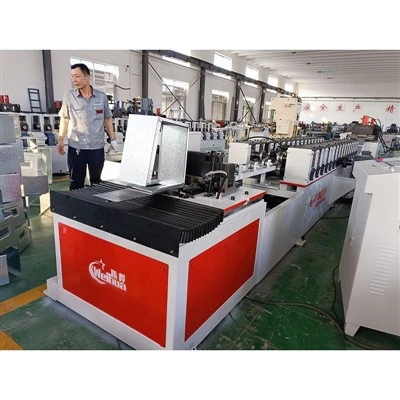
First off, let’s cut the jargon. Roll-forming isn’t stamping, it’s not bending with a giant press, and it’s definitely not 3D printing metal for small runs (though I’ve had a guy ask me that before, just ‘cause he’s never seen a production line). It’s a continuous process, right? You feed a long, flat, coiled strip of steel—usually galvanized, ‘cause cabinets need to hold up to dust, moisture, and whatever gets spilled on a job site—into a series of pairs of rolls. Each pair doesn’t just crunch the metal flat; each roll has a custom groove cut into it that matches a tiny, incremental part of the final profile. By the time the strip works its way through 10 to 20 of these roll sets, it’s shaped into the exact U-channel, angle, or custom rail you specified, no heat required most of the time.
Wait, why no heat? A lot of guys new to the game ask why we don’t use hot forming. The answer is consistency. If you heat steel, it can shrink unevenly, warp when it cools, and you waste a ton of material trimming the edges. For electrical cabinets, every millimeter matters—you need the mounting holes to line up, the door rail to fit exactly on the frame, no gaps that let dust seep in or breakers rattle loose. Cold roll-forming keeps the metal’s tensile strength consistent, too. We test every batch with a basic pull test: if a profile snaps when we yank on it with 2,000 pounds of force, we adjust the roll pressure before sending it out. Last year I had a client who was using cheap imported profiles that bent just putting a heavy bus bar in—cost them $15k in replacement parts before they switched to our line. That’s the stuff you fix with roll-forming tweaks.
Let’s walk through the process step by step, like we’re standing right next to our production line in the shop. First, the uncoiler. That’s a big, motorized reel that holds the 10,000-pound coil of steel—we can run that for 2 hours straight without reloading, which is why it’s way better than cutting the strip to length first and bending it piece by piece. The strip comes off the uncoiler, but it’s a little wobbly when it’s tight off the coil, right? So first stop is the leveler. It’s another set of small, rotating rolls that stretch and flatten the strip just enough so there’s no wave or kink before it hits the forming rolls. Kinks in the raw material are a killer—they throw off the alignment of every roll after that, so you end up with a profile that’s not straight. I’ve fixed lines where the leveler was broken just by shimming one roll half a millimeter, and suddenly the whole run was perfect.
Next, the forming section. This is where the magic happens (no, not magic, just math). Each roll pair is spaced about a foot apart on the line, and each groove is slightly different. Let’s say we’re making a standard cabinet frame U-channel: the first roll set bends the strip 20 degrees along each long edge. The next set adds 15 more, so now it’s 50. We keep going, 5 more degrees each time, until the edges are bent 90 degrees to make the U. We never try to bend it 90 degrees in one roll— that’s how you get cracks or the metal stretches thin in the bends, which makes it weak. I once had a new operator try to speed up a run by skipping a roll set, and half the profiles got so thin in the bends that they broke when we did the pull test. Cost us $800 in scrap material, and a whole day of re-running the order. Lesson learned: slow and steady wins the roll-forming race.
Then, after all the forming rolls, we hit the cut-off press. This is the part that cuts the long, continuous profile into exact lengths—usually 8, 10, or 12 feet, whatever the cabinet maker needs. The cool thing here is that it’s a flying cut-off, right? It doesn’t stop the whole line to cut; the press moves along with the profile as it’s coming through, so we don’t lose 10 feet of material every time we start and stop. That’s a huge efficiency gain. We can run our line at 60 feet per minute during peak times, which is way faster than any other method for high-volume profiles.
Wait, what about custom profiles? A lot of cabinet makers don’t use standard U-channels—they have weird internal mounting rails, or grooves for door seals, or even cutouts for cable glands. When we get a custom order, the only thing that changes is the forming rolls. We mill new rolls from tool steel, cut the exact profile into each groove, and swap them out in about an hour. No reconfiguring the whole line, no custom tooling that takes weeks to make. That’s why our clients love us—if they need a small batch of 50 profiles for a one-off cabinet project, we can swap rolls and do it in a day, no problem.
But it’s not just rolls and steel. We have a few key parts of the line that make sure the profile doesn’t go wonky mid-process. First, the guiding system. Along the forming section, there are little clamps that hold the strip dead-center as it moves through each roll. If it shifts even a sixteenth of an inch, the whole profile is off. Last month, we had a sensor on the guide break, so the strip shifted, and we had to scrap 2,000 feet of material. Now we do a 10-minute check on the guides every morning before we start a run—small thing, but it saves us a ton of money.
Then there’s the post-forming inspection. We don’t just cut and ship. After the cut, every profile gets a quick visual check, plus we run a caliper over the edges to make sure they’re the right width, and we test the bend radius—too sharp and it’s weak, too rounded and it doesn’t fit into the cabinet frame. We also do a salt spray test on every batch of galvanized steel profiles, to make sure they won’t rust if they’re used outdoors or in a damp basement. Last year we had a client who used our profiles in a substation in Florida—salt air out there is brutal, and their cabinets still look good 2 years later. That’s the quality we stand for.
I get it, for someone who’s never been inside a production line, this all sounds like a black box. But it’s not. It’s just a bunch of precise, rotating rolls shaping metal incrementally, with checks every step of the way to make sure it’s exactly what you need. The worst mistake I see new cabinet makers make is buying cheap profiles from suppliers who skip steps—they use too few rolls, rush the cuts, or use low-grade steel. You end up with cabinets that don’t fit together, that rattle, that rust, that can’t hold the electrical load. I’ve seen cabinets where the frame bent just from mounting a 100-amp breaker, and that’s not just a nuisance—it’s a safety hazard.
If you’re in the market for an electrical cabinet profile production line, or you need custom profiles for your current line, don’t settle for a supplier who just says “we do roll-forming.” Ask them about their roll count, their inspection processes, how they handle custom orders. Ask if they’ll do a test run of your profile before you commit. That’s what we do—we’ll send you a sample of whatever profile you need, for free, so you can test it, bend it, hit it, whatever, before you buy the whole line. No strings attached, because we know once you see the difference between a well-rolled profile and a cheap one, you’ll come back.

Roll-forming isn’t rocket science, but it’s not something you can wing either. It’s the reason electrical cabinets work as well as they do—they’re built on the precision of those little rolls, one after another, shaping metal into something sturdy, consistent, and reliable. If you’re looking to upgrade your production line, or you just want to stop dealing with flimsy profiles that cause headaches, hit us up. We’ll walk you through every step, help you figure out exactly what you need, no jargon, no pressure. Just real talk from a guy who’s been in this shop for decades, fixing lines and making profiles that stand the test of time.
Electrical Cabinet Profile Production Line Reference:
- Halmos, G. T. (2006). Roll Forming Handbook. CRC Press.
- Smith, L. (2019). Advances in Cold Roll Forming for Structural and Electrical Applications. Journal of Metal Forming Technology.
- Electrical Manufacturers Association (EMA). (2021). Standard Practices for Enclosure Profile Manufacturing. EMA Publication EMA-ES-12-21.
- Tschaetsch, H. (2012). Fundamentals of Cold Forming of Steel. Springer-Verlag.
Weifang Yue Jun Machinery Co., Ltd.
With abundant experience, we are one of the most professional electrical cabinet profile production line manufacturers in China. We warmly welcome you to buy durable electrical cabinet profile production line made in China here from our factory. We also accept customized orders.
Address: Kuiwen District, Weifang City, Shandong Province
E-mail: adrian@yuejunmachinery.com
WebSite: https://www.yuejunmachinery.com/
